
Why Mother’s Day Hits Like a Punch: Surviving Social Comparison and Divorce

Every year, as Mother’s Day approaches, a specific kind of heaviness sets in. It’s not just a passing sadness; it’s a weight that many of us carry silently in our chests. If you find yourself feeling more anxious than celebratory, there is a biological reason for it.
It’s rooted in a concept called Social Comparison. I vaguely remember sitting in a lecture hall back in the 90s, scribbling notes about psychology and the way humans evaluate themselves against the "herd." Back then, it was just a sterile theory on a chalkboard. I had no idea that decades later, this academic concept would move out of the textbook and into my driveway, manifesting as a physical ache.
Mother's Day isn't just hard because we are alone now; it's hard because it reminds us of the years we spent feeling alone even when we weren't.
The Comparing

We were still married when I remember moving into a new neighborhood, just as spring was coming. I was talking with some moms after school, and they were mentioning that their kids and husbands were taking them out for brunch. I remember thinking, “Well, isn’t that interesting?” and “Why not me?” My children made lovely homemade gifts, but my ex did very little to celebrate the day.
The reality inside my house was very different. I was already navigating a deep, personal loss—my own mother had died suddenly from a brain tumor the year prior. Mother’s Day was already a landmine of grief. Before she died, I was the one who did all the work; I made sure both our mothers were honored.
When I finally asked about his lack of care, he simply said with a grin: "You’re not my mother." I think he thought he was funny. It was a technically true statement used to mask a total lack of intention. He wasn’t just refusing to buy a card; he was refusing to acknowledge that I was the mother of his children. I realized later it was what he learned as a child; his own father would state that exact same thing to his mother.
Why Does Comparison Hit Like a Punch?
If you have felt yourself comparing your life to others, your brain was likely doing what researchers call a "comparison audit."
The Survival Mechanism: In the wild, being "separate" from the herd meant danger. Our "fight or flight part of our brain releases cortisol (the stress hormone) when it senses we are unsupported. That heavy feeling is literally a chemical alarm.
The "Highlight Reel" Trap: We engage in Upward Comparison, where we compare our messy "behind-the-scenes" to someone else’s "highlight reel." Your brain tries to bridge that gap with a lie: "It must be my fault and I am a failure.
The Truth: The Burden You Carried
That feeling of "coming up short" belongs to the marriage, not to you.
I remember my daughter’s birthday party. The house was full of friends and parents. It should have been a team effort. Instead, I was the host, the entertainer, and the parent on duty, while he stayed downstairs sleeping through the entire event.
Watching "functional" families isn't a reminder of what you couldn't do, it’s a reminder of what you were trying to build by yourself. When you are grieving your own mother and raising children without a partner who supports you, you aren't doing "half" the work. You are doing double.
How to Navigate the "Heavy" This Week
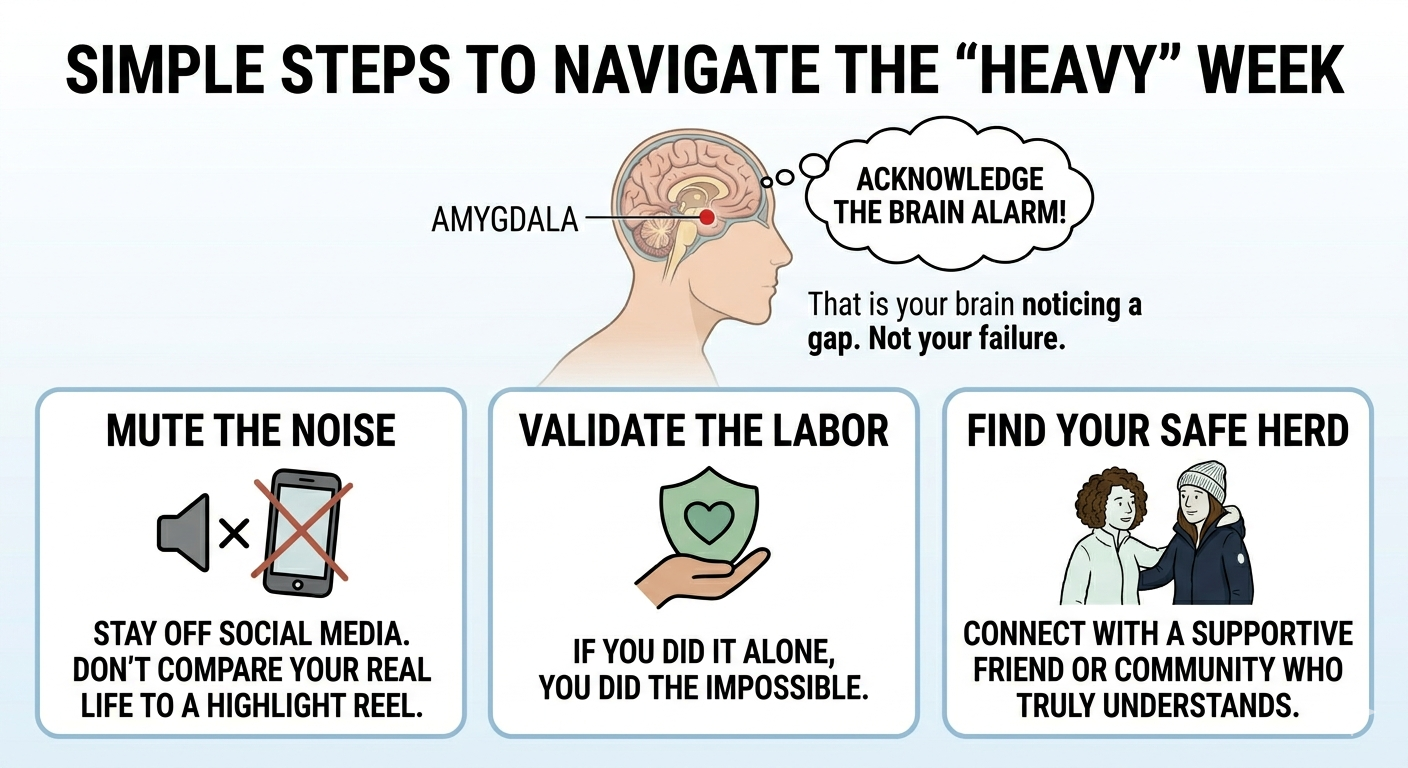
Acknowledge the "activated fight and flight ": Say it out loud: "That is just my brain noticing a gap. It is not a reflection of my worth."
Mute the Noise: Stay off social media. Don't compare your real life to someone else's highlight reel.
Validate the Labor: If you did this work alone, you did the impossible.
Reclaiming Your Worth
Today, my children are young adults. Do they really appreciate me fully yet? No. But I do think they understand more of the sacrifices I made. If I get the odd "thank you," that is okay by me. I know what it took to stay standing.
In reality, we will probably always deal with some social comparison—we are human, after all. But now, we understand why. We can acknowledge the "neurochemical ouch" and reframe it.
You are no longer exhausted from the task of holding everything up while someone else sleeps downstairs. This year, the peace you have built is the greatest gift you could ever give yourself.

Take the Next Step with Confidence
Divorce is overwhelming, but you don't have to navigate it blindly.
Just Separated: A Hands-on Workbook for Your Separation and Divorce is designed to be your practical roadmap through the emotional and legal fog. Instead of a dense manual, it’s a toolkit you can jump into exactly where you need help most—whether that’s co-parenting logistics or reclaiming your financial independence.
Stop guessing and start rebuilding.
👉 [Download your free 22-page sample here] 📖 [Order the full workbook on Amazon Worldwide]