
It took me a long time to figure out who I was married to and even longer on why I was obsessed with researching it.

Interestingly, towards the end of the marriage I knew something was not right with him because I bought the book Character Disturbance: The Phenomenon of Our Age by Dr. George Simon. This book is about how society faces a rise in people who lack accountability, manipulate others, and exploit social rules without guilt, and a widespread lack of character. I placed it on the kitchen island, assuming he would look at the cover. He saw it, and he just kind of laughed.
To this day, I am not entirely sure why I did that. It was as if I could somehow ‘teach’ him that something was wrong, I had been trying to teach him for years and I was hoping a final lightbulb would finally go off with him. He picked it up and said is this for me and slightly laughed it off and put it back down on the table.
When he started struggling with a business venture, I tried again to help him reflect. I asked, 'What would your father say to you?' He said nothing.
What is interesting is that while I had an inkling something was off during the marriage, the full picture didn't click until a year after we separated. That was when I finally realized I had been married to an antagonistic personality.
Starving for Logic
When you are dealing with someone who constantly destabilizes your reality, you become starving for logic.

During that period, my life was a relentless balancing act. I was juggling the intense academic and emotional load of completing my thanatology degree, navigating the daily realities of raising my kids with primary custody, and trying to keep our lives afloat. My nervous system was trapped in a perpetual state of high alert, and I was running on a level of bone-tired exhaustion that settles deep into your bones.
I began ‘studying’ how he became the way he was. I wasn't just reading casual pop-psychology blogs or going on TikTok. I dug deep into scholarly papers and even took professional certifications to understand exactly how antagonistic personalities are formed.
In that chaotic environment, information mimics safety.
I mistakenly believed that if I could just figure out the psychology of why he was doing this, I could predict his next move. And if I could predict his next move, I could protect myself and my kids.
I began "studying" how he became the way he was, frantically analyzing what he had actually been like during the entire marriage. I mistakenly believed that if I could just figure out the psychology behind everything he had done to us, I could finally predict his next move. And if I could predict his next move, I could protect myself and my kids.
When you are a recovering fawner, that need to figure him out doesn't just stop when you leave. Your mind goes into overdrive, treating the past years of your marriage like a crime scene. You look backward under a microscope, obsessively analyzing his history, his patterns, and his past behavior, believing that if you can just decode the truth of what happened, you can finally feel safe.
The Subconscious Emergency Brake
What I didn't know then is that psychology has a specific name for this: intellectualization.
When the emotional pain of betrayal, the uncertainty of a courtroom battle, and those desperate, spinning loops of, "There’s no way he’s actually doing this, right?" and “Does he love his children?'“ become too heavy for your system to digest, your subconscious pulls an emergency brake. It looks at a raw, agonizing emotional reality and decides it is simply too dangerous to feel. So, it translates that agony into an academic problem to solve.
It didn't help that I am an inherently curious person by nature. I have a mind that naturally wants to figure things out and I often research a lot of things so finding the ‘why’ behind things is quite normal for me. When my life began to unravel, my brain defaulted to its favorite setting: let’s analyze this.

All that studying did teach me a lot about how toxic people operate. But looking back, I can see that my intellect and my natural curiosity were acting as a sophisticated shield. By staying completely consumed with analyzing his childhood trauma, his entitlement, and his cold family history, I could safely delay the brutal pain of reality.
And if I’m being completely honest? Looking back at that period now makes me angry. I feel a sharp, burning frustration at the sheer volume of time, energy, and life force I traded away trying to decipher a person who was never, ever going to change.
I spent years of my life acting as a researcher for a relationship that was already a mess, and I was desperately looking for a key to a lock that didn't exist.
Standing Outside the Truth Room™
Studying him under a microscope kept me standing right outside the threshold of what I call The Truth Room™, the space of absolute, radical acceptance.
Inside that room was the brutal, unvarnished weight of my actual experience, the things all my research and natural curiosity were protecting me from facing. My intellect was acting as a buffer because walking into that room meant radically accepting truths that my nervous system wasn't ready to digest:
The true weight of the years of betrayal.
The reality of the harm being done to my family.
The devastating realization that the partnership I was abandoning myself to protect had only ever been a solo effort—that I had never actually been safe.
The void left inside my own self-worth.
My research was a necessary survival strategy for a time. It gave my analytical mind a job to do while my heart was in shock, keeping me moving when the alternative was absolute collapse.
Related Reading:
When I look back on that time now, I realize it wasn't a total waste of time. Not at all. That deep dive changed my life, shaped my understanding, and gave me the precise tools I use today to help the clients I work with.
But there was a hidden cost. In the absolute consumption of researching him, I completely forgot about myself. I ignored what I actually, deeply needed because I was too busy analyzing his pathology.

And that is exactly why I am writing this blog for you. I don't want you to spend years of your precious life stuck in that endless loop of decoding another person. I want to help you shorten that timeline.
Because the biggest lesson I learned on this research that was hard for me to swallow: You cannot research your way out of trauma and grief, and you cannot fix a deep emotional wound with intellectual facts.
Eventually, the books have to close. The analysis has to stop. And we have to finally cross the threshold, pull the emergency brake on our minds, and step into the room where the radical acceptance begins.
It is a terrifying step to take, but it is also the exact point where your real life begins again. When you finally stop studying the person who broke you, you get to use that immense, beautiful life force to rebuild yourself. You stop being the forensic scientist of your past, and you finally become the architect of your future.
Step into the room. The truth won't break you, it's the only thing that will finally set you free.
References
Durvasula, R. (2024). It's Not You: Identifying and healing from narcissistic people. Avery.
Freud, A. (1936). The ego and the mechanisms of defence. Hogarth Press.
Simon, G. K. (2011). Character disturbance: The phenomenon of our age. Parkhurst Brothers Publishers.
Stop the Research. Get Your Life Back.
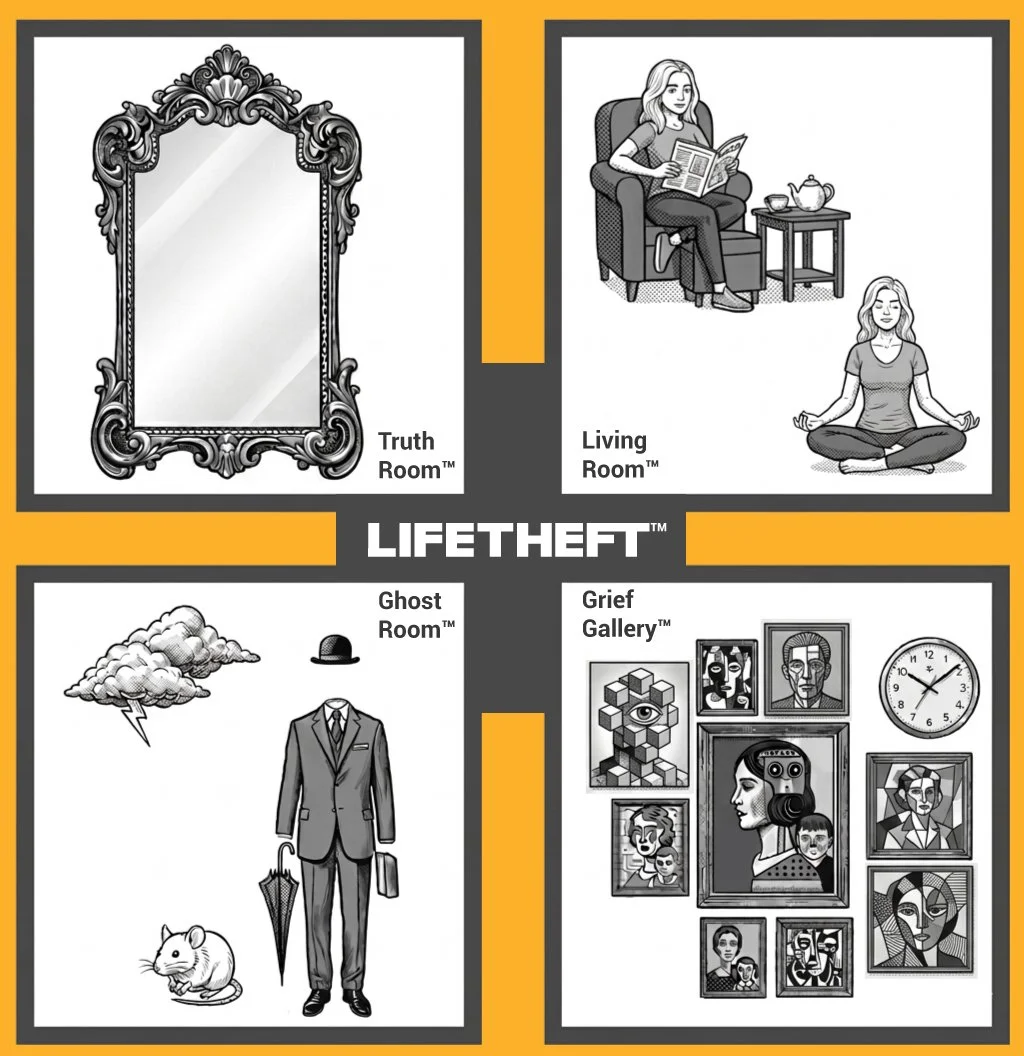
My upcoming book, LifeTheft: Healing from the Losses of Narcissistic Abuse, launches this October 2026, but you don’t have to wait until then to start stepping into the Truth Room™.
Don't spend another year trading away your precious life force trying to decode someone who will never change. Join my inner circle today to shorten your timeline and reclaim your future.